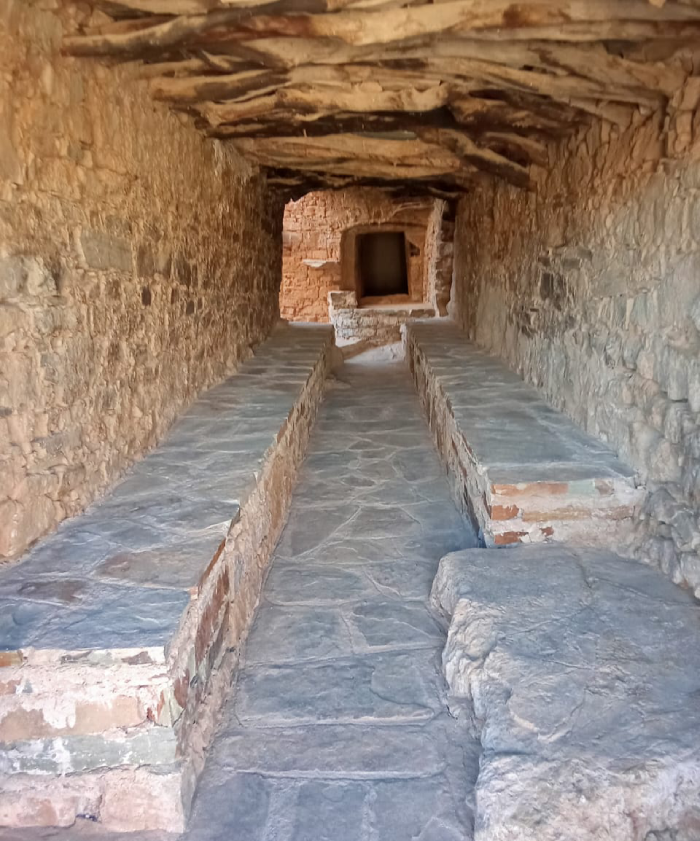
Exploring the fascinating history, architecture and cultural heritage of southern Morocco's traditional communal granaries.
The Hidden Fortresses of the Anti-Atlas
Across the rugged mountains and valleys of Morocco's Anti-Atlas, remarkable stone buildings stand on rocky hilltops, overlooking traditional villages, cultivated terraces and dry river valleys. From a distance, some resemble small castles or fortified villages. Their thick walls, compact towers and rows of tiny openings tell a fascinating story of a time when protecting food, family possessions and community resources was essential to survival.
These extraordinary structures are known as Igoudar, the plural of Agadir in the Amazigh language. Often described as fortified communal granaries, they represent one of the most distinctive examples of traditional architecture in southern Morocco.
However, Igoudar were much more than simple warehouses. They were carefully organised community institutions designed to protect the resources and valuables of families living in remote and sometimes challenging environments.
For travellers exploring the Anti-Atlas, discovering an Agadir offers a unique opportunity to look beyond Morocco's famous imperial cities and coastal resorts. It is a journey into Amazigh history, traditional architecture, local ingenuity and the remarkable relationship between people and their environment.
What Exactly Are Igoudar?

An Agadir is a fortified communal storehouse in which families or households belonging to a village or wider community traditionally kept their agricultural products and valuable possessions.
The plural form, Igoudar, is particularly associated with the Anti-Atlas and Souss regions, although similar collective storage traditions can be found elsewhere in Morocco.
Each participating family generally had one or more private storage compartments within the larger complex. These small rooms could contain:
- Barley, wheat and other cereals.
- Almonds, dates and dried agricultural products.
- Olive oil, honey and other food supplies.
- Jewellery and valuable personal belongings.
- Money, legal documents and important family records.
- Clothing, carpets, tools and household objects.
The Agadir therefore served two essential purposes: protecting food supplies and safeguarding the wealth of local families.
In regions where drought, poor harvests and occasional insecurity could threaten livelihoods, having a secure communal storage facility was extremely important.
It also represented a remarkable form of cooperation, as several families shared responsibility for maintaining and protecting a common structure.
Why Did Amazigh Communities Build Fortified Granaries?

The construction of Igoudar was closely connected to the geographical, climatic and social conditions of southern Morocco.
The Anti-Atlas is characterised by mountainous terrain, relatively low rainfall, rocky landscapes and traditional agricultural settlements. For generations, local communities developed practical solutions to manage limited resources and protect their livelihoods.
There were several important reasons behind the construction of these fortified granaries.
1. Protecting Food Supplies
Agriculture was the principal source of livelihood for many communities. Families depended on cereals, almonds, olives and other locally cultivated products.
Because harvests were not always predictable, storing food for future consumption was essential.
The granaries provided a secure environment where agricultural products could be kept for extended periods, helping families prepare for difficult seasons and potential shortages.
2. Safeguarding Family Wealth
An Agadir was also a communal safe.
Before modern banking facilities and secure domestic storage became widely available, families needed a protected place to keep valuable possessions.
Jewellery, money, important documents and other belongings could be stored inside individual compartments, protected by the building's security arrangements.
3. Security and Defence
Many Igoudar were strategically constructed on elevated rocky locations, making access difficult for outsiders.
Their thick walls, controlled entrances and sometimes defensive towers helped protect the contents against theft and attacks.
Some could also provide refuge during periods of insecurity, although their defensive role varied according to the location and historical circumstances.
4. Community Cooperation
Perhaps the most interesting aspect of the Agadir tradition was the organisation required to operate these structures.
The granaries belonged to a system of collective management in which families shared responsibilities, followed agreed regulations and participated in maintaining the building.
This demonstrates how Amazigh communities developed practical systems of cooperation and local governance long before modern administrative institutions.
The Architecture of Igoudar: Ingenious Design Adapted to Nature

One of the most fascinating aspects of Igoudar is their architecture.
Although their appearance varies from one location to another, many share recognisable characteristics that reflect the construction knowledge of traditional Amazigh communities.
Strategic Locations
Many granaries were constructed on rocky hills, elevated ridges or naturally protected positions.
These locations offered several advantages:
- Easier surveillance of the surrounding countryside.
- Natural protection provided by the terrain.
- Difficult access for potential intruders.
- A strong foundation for heavy stone structures.
Their positions also created some of the most impressive architectural landscapes in the Anti-Atlas.
Traditional Building Materials
Local materials were central to their construction.
Stone was widely used for foundations and walls, while earth-based mortars helped bind the structure. Timber was used for doors, beams, lintels and roof elements.
The use of locally available materials reflects the practical knowledge of traditional builders, who understood how to construct durable buildings using the resources available in their surroundings.
Thick Walls and Controlled Entrances
The thick exterior walls gave many Igoudar their fortress-like appearance.
Access was generally concentrated through a limited number of entrances, allowing the community to control who entered the building.
Some complexes also included towers or additional defensive features.
Rows of Storage Chambers
Inside, the granary was divided into numerous small compartments, sometimes arranged on several floors.
Each family had designated storage spaces, which could be secured with individual doors and locks.
The arrangement allowed several households to use the same building while keeping their possessions separate.
Natural Protection
The thick walls, shaded interior spaces and carefully designed openings helped protect stored products from direct sunlight and outside exposure.
The exact arrangements varied from one granary to another, reflecting differences in climate, building techniques and local traditions.
How Were Igoudar Managed?

The management of Igoudar is just as fascinating as their architecture.
These structures were not simply buildings shared by several families. They operated according to traditional rules and regulations established by the communities themselves.
Such rules could cover:
- Ownership and inheritance of storage compartments.
- Access to the building and its opening hours.
- Responsibilities for maintenance and repairs.
- Security arrangements and the management of keys.
- Penalties for theft or violations of community regulations.
- The settlement of disagreements between members.
A trusted individual, sometimes known as Lamine, could be appointed to supervise the granary.
Depending on local customs, this person might be responsible for keeping keys, controlling access, monitoring the building and ensuring that community rules were respected.
Community assemblies and councils also played an important role in decision-making.
This traditional system demonstrates an impressive level of organisation and collective responsibility. It is an important part of the social history of Amazigh communities in southern Morocco.
The Cultural and Social Importance of Igoudar

To understand an Agadir only as a fortified granary would be to overlook much of its significance.
These structures represent the relationship between architecture, economy, social organisation and cultural identity.
For generations, the granaries helped families manage uncertainty and protect the products of their work. They also embodied the idea that certain risks were better faced collectively.
Building, maintaining and administering such a structure required trust, shared rules and a sense of responsibility towards other members of the community.
Some granaries were also connected to local religious traditions, customary gatherings and networks linking villages with wider regional communities.
Today, Igoudar are valuable records of Amazigh knowledge, demonstrating how communities built with local materials, organised common resources and adapted to challenging environments.
They are not simply architectural monuments; they are symbols of a collective way of life.
Where Can You Discover Remarkable Igoudar in the Anti-Atlas?

The Anti-Atlas and the wider Souss-Massa region contain numerous fortified granaries, ranging from well-known restored sites to lesser-known structures that remain part of the surrounding landscape.
Some are particularly impressive because of their architectural design, historical importance or spectacular geographical setting.
Here are several examples worth discovering.
1. The Fortified Granaries of Amtoudi
Among the most spectacular examples are the fortified granaries of Amtoudi, located south of the main Anti-Atlas routes.
The village is famous for its dramatic geographical setting, with traditional houses and cultivated areas surrounded by steep rocky mountains.
Its granaries occupy commanding positions above the valley, creating an unforgettable image of traditional architecture integrated into the landscape.
The elevated position, stone construction and fortified appearance make Amtoudi particularly interesting for visitors wishing to understand the defensive and storage functions of an Agadir.
The wider area is also known for its beautiful oasis scenery, mountain paths and traditional rural settlements.
A visit can be combined with a walk through the village and surrounding valley, offering opportunities to discover local life and appreciate the spectacular natural environment.
2. Agadir Inoummar
Agadir Inoummar is another notable fortified granary associated with the heritage of southern Morocco.
Like other Igoudar, its interest lies not only in its exterior walls but also in the way the building reflects the community's approach to security, storage and shared responsibility.
It represents an important part of the architectural heritage of the region and provides another example of the traditional collective storage system that once played an essential role in rural life.
Visitors should confirm local access arrangements before travelling, as some historic granaries are fragile, community-managed or undergoing conservation work.
3. Agadir Tasguent
Tasguent is frequently cited among the remarkable fortified granaries of southern Morocco.
Its traditional construction and geographical setting illustrate the close relationship between the Agadir and the rugged topography of the Atlas and Anti-Atlas landscapes.
Like other granaries, Tasguent should be understood as a living part of local heritage rather than simply a photographic monument.
Respect for the site and the community responsible for its preservation is essential.
4. Agadir Ighir Ifrane
Located in the commune of Ida Ougnidif, in Chtouka Aït Baha Province, Agadir Ighir Ifrane is an important example of a traditional granary that has benefited from restoration and tourism-development initiatives.
Regional tourism authorities describe it as a stone structure with three floors and two rows of approximately 90 storage rooms, arranged along a corridor around 50 metres long.
The restoration project involved cooperation between regional and local institutions, heritage specialists and a local association.
It demonstrates how conservation can help safeguard traditional architecture while creating opportunities for cultural discovery and sustainable tourism in rural areas.
Ighir Ifrane is particularly interesting for travellers exploring the Aït Baha area and the wider Anti-Atlas.
5. Imchguiguiln and Other Granaries of the Souss
The Souss-Massa region also contains collective granaries beyond the most frequently visited Anti-Atlas routes.
Imchguiguiln, for example, is mentioned in regional ecotourism material as a granary that can be visited a short distance from Agadir.
These sites remind visitors that the Agadir tradition is not confined to one village or mountain valley. It forms part of a wider cultural landscape connecting settlements, agricultural areas and historic routes throughout southern Morocco.
Igoudar and the Natural Environment of the Anti-Atlas

The location and construction of many Igoudar reveal how closely traditional communities adapted their buildings to the natural environment.
Rocky ground could provide a strong foundation and a natural defensive advantage. Stone and earth were sourced locally, while timber was selected from materials available in the surrounding region.
The granaries also belong to landscapes shaped by:
- Traditional dry farming.
- Argan forests and almond cultivation.
- Terraced agricultural fields.
- Oasis valleys and seasonal watercourses.
- Traditional villages and mountain settlements.
Their history is inseparable from the agricultural knowledge that allowed communities to survive and develop in a challenging climate.
Today, these buildings offer useful lessons in resourcefulness and traditional construction. However, their preservation requires regular care, appropriate restoration and the continuation of local building knowledge.
Why Are Many Igoudar at Risk Today?

Despite their historical and architectural importance, many traditional granaries face serious conservation challenges.
Changes in rural life have affected their original purpose. Improved transport, modern storage facilities, migration and changing livelihoods have reduced the need for some communities to use traditional communal granaries.
As a result, certain buildings have gradually been abandoned.
Without regular maintenance, stonework, earth-based mortar, timber elements and roofs become vulnerable to rain, wind, erosion and structural deterioration.
Conservation is therefore not simply a matter of repairing walls. It also involves recognising the rights and knowledge of local communities, documenting traditional construction methods and supporting associations responsible for maintaining these structures.
Tourism can contribute positively when managed responsibly. Visitors generate awareness and can support local guiding services and conservation initiatives.
However, tourism must respect the historical character of these places and the communities that continue to look after them.
How to Visit an Agadir Responsibly

For visitors interested in exploring these remarkable structures, a few recommendations can help ensure a pleasant and respectful experience.
Arrange access in advance: Some granaries are on community or private land, may be closed, or may require a local custodian to open them.
Consider a local guide: A knowledgeable guide can explain the history, architecture, local terminology and community traditions.
Respect the buildings: Avoid climbing fragile walls, forcing doors, removing stones or touching objects that may belong to local families.
Ask before taking photographs: Be considerate when photographing residents, custodians and private spaces.
Support local communities: Where available, use local guiding services and purchase locally made products directly from artisans.
Wear suitable clothing and footwear: Access routes can be steep, rocky or uneven. Carry water and protect yourself from the sun, especially during warmer months.
Combining Igoudar with an Anti-Atlas Journey

The fortified granaries can be highlights of a wider journey through the Anti-Atlas, a region known for dramatic mountains, traditional villages, oasis valleys, argan and almond landscapes, and a strong Amazigh cultural identity.
Depending on the chosen route and available time, visitors can combine a granary visit with several other remarkable destinations.
Some interesting combinations include:
- Aït Baha and Tizourgane: Discover traditional mountain villages and the historic Kasbah of Tizourgane.
- Tafraout and the Ameln Valley: Explore spectacular granite formations, Amazigh villages and traditional agricultural landscapes.
- Aït Mansour Oasis: Discover a beautiful palm-lined valley surrounded by dramatic rocky mountains.
- Amtoudi and its surroundings: Combine the fortified granaries with the village, oasis landscapes and mountain walking opportunities.
These destinations are spread across a large geographical area, so a realistic itinerary should allow sufficient time for driving, walking and local visits rather than trying to cover everything in one day.
For travellers starting in Agadir, a local transport provider or tour operator can help organise a suitable route.
Why Igoudar Deserve a Place on Your Morocco Itinerary

Morocco's most famous monuments often tell the stories of dynasties, cities and royal power.
The Igoudar tell another kind of story: one rooted in village life, family security, shared resources and the collective intelligence of mountain communities.
They are architectural landmarks, but they are also evidence of how people organised everyday life in an environment where cooperation was essential.
Their stone walls and small storage chambers preserve a heritage of craftsmanship, customary rules and local knowledge.
For curious travellers, visiting an Agadir offers something different from a conventional sightseeing stop. It creates an opportunity to learn about Amazigh heritage, discover the landscapes of the Anti-Atlas and understand the communities whose history gives these places their meaning.
These extraordinary granaries are among the hidden cultural treasures of southern Morocco and deserve greater recognition among travellers interested in authentic experiences.
Discover the Anti-Atlas with Agharass Tours
At Agharass Tours, we believe that discovering Morocco means exploring its landscapes, meeting its people and understanding the traditions that have shaped local life.
Based in Agadir, we arrange private transportation, excursions and tailor-made journeys across southern Morocco.
The Anti-Atlas offers rewarding experiences for travellers interested in cultural heritage, traditional architecture, rural life and lesser-known destinations.
Whether you wish to discover the fortified granaries of the region, explore the villages around Aït Baha and Tafraout, visit the dramatic setting of Amtoudi or combine cultural discoveries with walks through mountain and oasis landscapes, our team can help organise a journey suited to your interests and schedule.
Travel beyond the familiar routes and discover the remarkable heritage of the Anti-Atlas with Agharass Tours.